🔫🐦Great Australian Bites: The Emu War of 1932
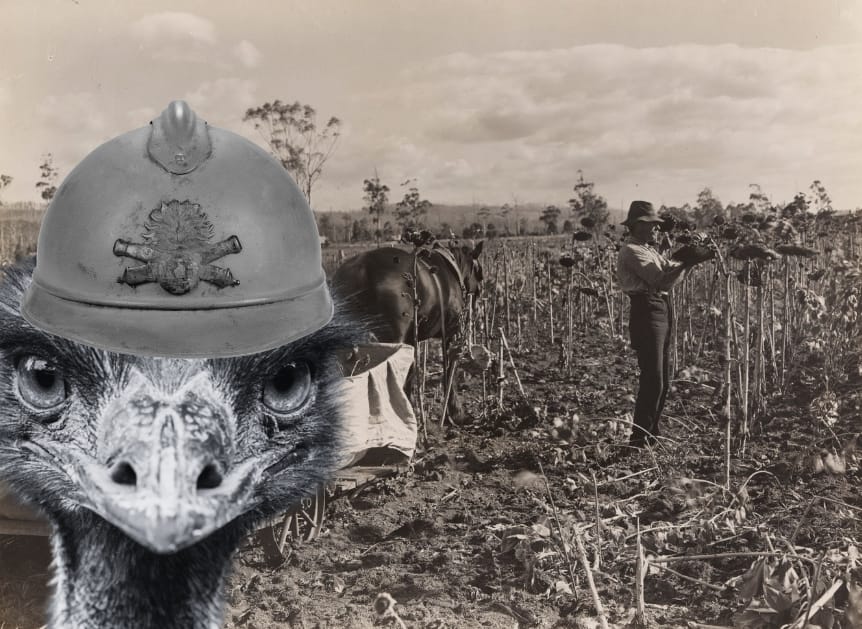
Great Australian Bites are stories on the more outlandish and weird side of Australian history, society and culture. In this story, we're covering the "Emu War" of 1932, a series of "nuisance animal" management operations conducted by the Australian military.
1. Historical Context
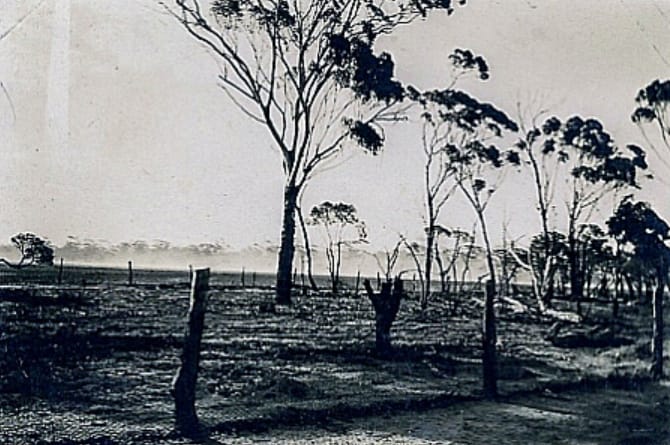
In the early 1930s, Western Australia faced severe economic hardship exacerbated by the Great Depression. Former soldiers, granted land under the Soldier Settlement Scheme post-World War I, struggled to farm wheat in marginal lands. Droughts and falling wheat prices pushed many to financial ruin, creating a crisis that set the stage for conflict with local wildlife (Johnson, 2006).
2. The Emu Migration Crisis
By 1932, approximately 20,000 emus migrated inland from coastal regions, converging on farmlands around Campion and Walgoolan. These flightless birds, capable of sprinting up to 50 km/h, ravaged crops, trampling fences and devouring wheat. Farmers, already desperate, viewed the emus as an existential threat (National Archives of Australia, 1932).
3. Farmers’ Pleas for Intervention
Frustrated by failed scare tactics, farmers petitioned the federal government for aid. The emus’ resilience—they could survive without water for days and adapt to harsh conditions—made traditional deterrence ineffective. The request for military assistance reflected the settlers’ desperation (Johnson, 2006).
4. Government Response
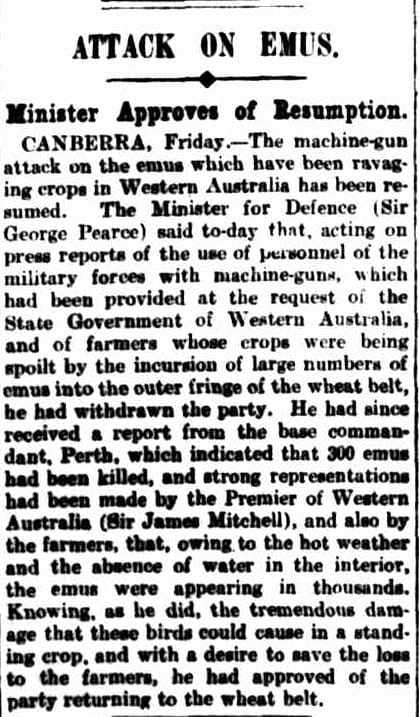
Defence Minister Sir George Pearce authorised a military deployment, partly to appease political pressure and demonstrate support for veterans. The operation, led by Major G.P.W. Meredith of the Royal Australian Artillery, included two soldiers with Lewis machine guns and 10,000 rounds of ammunition (The Canberra Times, 1932).
5. Initial Military Engagement (November 2, 1932)
The first confrontation occurred near Campion. Soldiers attempted to ambush emus, but the birds scattered in small, agile groups. The Lewis guns jammed frequently, and emus survived multiple gunshots, highlighting the mismatch between military technology and mobile wildlife (Johnson, 2006).
6. Media Ridicule and Public Reaction
News coverage mocked the operation’s inefficacy. The Daily Herald (UK) quipped that the emus had “won the first round,” while Australian papers depicted soldiers as outwitted by birds. Public criticism grew over the cost and absurdity of using wartime tactics against animals (The West Australian, 1932).
7. Tactical Adjustments and Renewed Efforts
After six days, Meredith repositioned guns near a local dam, aiming to target emus at watering holes. While this strategy slightly improved efficiency, emus continued to evade sustained fire. Reports noted 50–200 kills per day, but ammunition shortages persisted (National Archives of Australia, 1932).
8. Withdrawal and “Defeat”
On November 8, the military withdrew due to poor results and negative press. Meredith famously remarked that emus could “face machine guns with the invulnerability of tanks.” Officially, 986 emus were killed with 9,860 bullets—or ten bullets per emu—a ratio deemed wasteful (Johnson, 2006).
9. Second Deployment (November 13–December 10, 1932)
Farmers lobbied for a renewed campaign, leading to a second deployment. Though Meredith claimed 986 kills, the operation failed to curb emu numbers. By December, the military permanently withdrew, declaring the issue a civilian matter (The Argus, 1932).
10. Aftermath for Farmers
Post-retreat, emu incursions continued. The government introduced a bounty system in 1934, paying farmers for emu scalps. This approach proved more effective, with 57,034 bounties claimed by 1934, underscoring the inefficacy of militarised solutions (Australian Senate, 1934). Despite the bounties claimed, it barely made a dent in the population of emus, and there are still many hundreds of thousands of emus in Australia today.
11. Political Repercussions
Critics lambasted Pearce for wasting public funds during the Depression. The debacle damaged his reputation, though he retained his seat. The episode became a cautionary tale about governmental overreach and misallocation of resources (Johnson, 2006).
12. Ecological and Cultural Legacy
Biologists later recognised emus as part of Australia’s ecosystem, advocating for non-lethal management. Culturally, the “war” became a symbol of human folly, inspiring memes, documentaries, and academic analyses of human-wildlife conflict (ABC News, 2019). Later
13. Historical Reinterpretations
Modern scholars view the event as a clash between industrialisation and nature. Johnson (2006) argues it highlighted the unpredictability of wildlife, while others frame it as a media spectacle that overshadowed farmers’ genuine struggles.
14. International Perspectives
Global media framed the conflict as a humorous oddity, diverting attention from Australia’s ecological challenges. The narrative of a “lost war” persists in popular culture, often detached from its socioeconomic roots (The New York Times, 1932).
15. Conclusion: Lessons Learned
The Emu War underscores the complexity of human-wildlife coexistence. While ineffective as a culling strategy, it prompted pragmatic policies and remains a reminder of humility in environmental management. Its legacy endures as a blend of tragedy and farce.
Sources
- Johnson, M. (2006). "Feathered Foes: Soldier Settlers and the Emu War of 1932." Journal of Australian Studies.
- National Archives of Australia. (1932). "Reports on Emu Control Operations."
- The Canberra Times. (1932). "War on Emus." November 3.
- Australian Senate. (1934). Report on the Emu Bounty System.
- The West Australian. (1932). "Emu War Farce." November 8.