🎙️🐨Fun with Aussie English 1: Cracking the Twang of “Straya”
Aussie English is a reflection of Australia’s laid-back culture and cheeky sense of humor, packed with linguistic surprises that can stump even native English speakers. We’ll sprinkle in a few linguistic terms to give you a bit of insight into the science of Aussie English.


In this series, we’ll take a fun look at what makes Aussie English special – from its distinctive accent that might make “mate” sound like “mite.” to love of abbreviations and playful nicknames. Aussie English is a reflection of Australia’s laid-back culture and cheeky sense of humour, packed with linguistic surprises that can stump even native English speakers. We’ll sprinkle in a few linguistic terms (don’t fret, we’ll explain them) to give you a bit of insight into the science of Aussie English. By the end, you’ll be understanding Aussies better, and maybe even yakking (chatting) like a local yourself. Ready to crack the code of Aussie lingo? Let’s dive in!
Australian English has a unique phonology (sound system) that sets it apart from other varieties of English. In this first part of our series, we’ll break down the key features of the Aussie accent in an easy-to-understand way.
Here are some key things that make the Aussie accent stand out:
1. The Absent “R” (Non-rhotic accent)
One hallmark of Australian (and British) pronunciation is that Aussies don’t pronounce the “R” sound at the end of words, unless it’s followed by a vowel. For example, “car” might sound like “cah”, and “teacher” comes out more like “teach-uh.” This is what linguists call a non-rhotic accent: the “r” is dropped in certain positions. However, if a vowel follows, Aussies will often link the r through (so “car engine” may sound like “cah-rengine”). The general Australian accent (the most common accent in cities) typically does this: “water” may sound like “wadah” and “forever” like “forev-uh.” As one accent guide notes, in this accent “if the letter ‘r’ is in the last syllable of a word, it’s usually not pronounced”. It might take a little getting used to, but soon you’ll hear “Australia” pronounced “Austraya” and it will sound perfectly normal!
2. Drawled Vowels and Fun Diphthongs
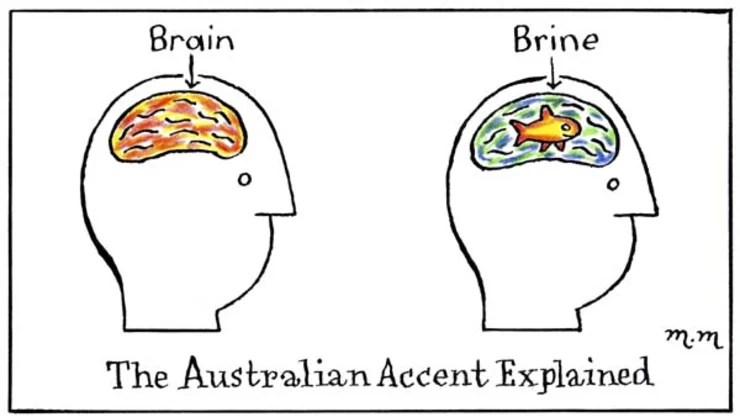
Aussies have some unique ways of pronouncing vowel sounds. In the very broad Australian accent, vowels can sound especially stretched or twisted. For instance, the vowel combination “-ife” as in “wife” or “life” might sound like “-oife” (so “wife” comes out a bit like “woife”). Similarly, the classic word “mate” in a thick Aussie accent might sound to American ears like “mite” or “might”. What’s happening is that the dipthongs (a fancy term for a vowel sound that glides from one vowel to another) are pronounced differently: often wider or more drawn out. Broad-accented Aussies might say “Australia” sort of like “Straya,” and “today” like “to-die.” On the other hand, a cultivated Australian accent (more like a posh or old-fashioned accent, similar to British RP) will pronounce vowels in a tighter, more clipped way. Most people you meet will have an accent in between these extremes (known as general Australian accent : common in cities and media), which is clear but still unmistakably Aussie.
3. The Great Aussie Syllable Smoosh
Another thing you might catch is that Australians sometimes flatten or omit certain sounds in casual speech. For example, the “t” sound in the middle of words often turns into a quick soft “d” or just a brief pause. “Better” might sound like “bedda,” and “later” like “lay-da.” This is common in many English dialects (Americans do it in “water” -> “wadder”), but you’ll definitely hear it Down Under. Also, “ing” at the end of words might come out as “in’.” So “I’m just waitin’ for my mate.” (And yes, there’s even a famous Aussie viral phrase “Not happy, Jan!” where “Jan” is said with a nasally twang… but we digress).
4. The Rising Tone (Australian Question Intonation)
Ever feel like Aussies sound like they’re asking a question even when they’re not? You’re not imagining it. Australian English is famous for the High Rising Terminal or “uptalk” – basically ending statements with a rising intonation as if it were a question. For example, “I had a great weekend.” (with a rising tone on “weekend?”) – to non-locals it might sound like “I had a great weekend?” (as if unsure). This doesn’t mean every Aussie talks like this, but it’s common enough that it’s a stereotype. It often serves a social function, like keeping the listener engaged or checking they’re following. So don’t be confused if it sounds like your Aussie friend is constantly seeking confirmation – it’s just a conversational style that says “I’m friendly and I’m checking you’re with me, mate.”
Putting It All Together
To sum up, Australian English phonology gives us a distinctive accent that’s instantly recognizable. It’s characterized by no pronounced R’s at the ends of words, smoothly blended consonants, and vowels that often tilt or stretch in charming ways. The accent ranges from the broad, nasal “Strine” drawl to a more cultivated lilt that could be mistaken for British with most people falling in between. Importantly, Aussies take pride in their accent as a marker of national identity, yet they keep it practical: the general accent ensures everyone from any region can communicate easily.
Now that we’ve tuned our ears to how Aussies sound, it’s time to look at the words and expressions they use. In our next series, we’ll explore Australian English morphology, basically, how Australians coin slang, shorten words, and create the playful vocabulary that leaves newcomers puzzled yet amused. (Crikey, it’ll be a fun ride!)